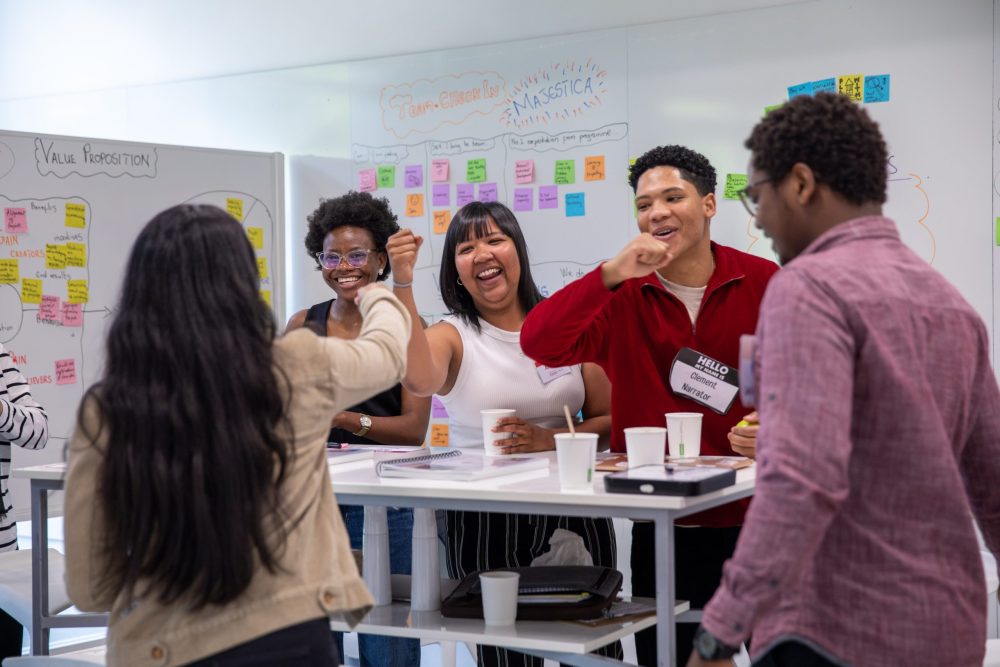
A practical, immersive learning experience designed to introduce and activate design-led mindsets through intentional learning moments that participants can apply immediately in their everyday contexts. The programme creates entry points for participants to begin thinking and acting differently, planting the seeds for longer-term growth and change.
Participants don’t just learn about design-led mindsets, they experience and practise them in diverse teams and leave with behaviours they can apply immediately in real life.
What matters most is in participants is curiosity, openness to experimentation, and a willingness to try new ways of thinking and acting.
This is a 1-day in-person The Everyday Designer programme that exposes participants to design-led mindsets through intentional learning moments.
https://us06web.zoom.us/j/87637063193?pwd=PmrMWa0Cbz4aaUJa9ibKQpqa8RZqib.1
Join us for an upcoming d.scovery Online Info Session where we’ll introduce two of our dynamic student programmes: Design Thinking Week and Design Thinking in Afrika. These immersive learning experiences are designed to help you build future-focused skills, grow your creative confidence, and tackle real-world challenges with empathy and innovation.
In this live session, you’ll meet the one of our programme leads and hear directly from past participants. Alumni will share their stories, reflections, and how the programme has impacted their journey. You’ll also have the chance to ask questions and gain practical insights into the application process and what to expect.
Introduction to Design Thinking is a programme specifically designed to provide students with the opportunity to enhance their critical thinking capabilities whilst working in diverse, multidisciplinary teams on real world problems. The programme simultaneously aims to build confidence in dealing with uncertainty and ambiguity as well as a human-centered approach to problem solving.
Participants will be provided with the opportunity to work in an environment that incorporates the uncertainty and complexity that goes along with operating in real life. In addition to this, participants will learn how to use design thinking structurally so as to enhance cross-disciplinary collaboration and co-creation.
This is a 2-day in-person Introduction to Design Thinking that exposes participants to working in multi-disciplinary teams on real world problems.
The Hasso Plattner d-school Afrika at UCT is the home of Design Thinking and a first for Africa and its people. Much like its predecessors in the USA (d.school) and Germany (HPI School of Design Thinking), d-school Afrika at UCT offers training and capacitation in design-led innovation.
Our Introduction to Design Thinking programme is specifically designed to help you enhance your critical thinking capabilities while working in diverse, multidisciplinary teams on real-world challenges. This programme builds confidence in dealing with uncertainty and fosters a human-centred approach to problem-solving.
Participants will engage in a real-world learning environment, embracing uncertainty and complexity while applying design thinking in practice. You’ll also learn how to use design thinking structurally, enabling cross-disciplinary collaboration and co-creation.
Dates: 18 – 19 March 2025
Time: 09:00 – 16:00
Venue: Hasso Plattner d-school Afrika at UCT
This is a free, two-day in-person Introduction to Design Thinking course, giving you hands-on experience in human-centred innovation and problem-solving.
Learn about the skills you’ll develop, the hands-on learning experience, and how design thinking can empower you to tackle real-world challenges. There will also be a Q&A session, giving you the chance to ask questions about the programmes and application process.
Don’t miss this opportunity to connect, learn, and discover how design thinking can shape your journey!
However, in parallel with the development of the practice, there are increasing calls to consider our work more critically, to re-frame and even to re-imagine it. Much of the criticism stems from the fact that many of the techniques and models used in design thinking come from contexts in the global North, . This has prompted us to ‘open up the practice’, enabling us to re-think and adapt our approach.
This is where the d-school Afrika’s Design Dialogues come into the picture. This is one way to respond to these calls for a critical examination of the work. Envisaged as ‘deep dives’ into the practice of design thinking, the d-school Afrika is planning four dialogues for 2024 offering a space for engagement and reflection with a wide range of stakeholders.
Our first session will feature a conversation between leading design thinkers from Kenya, the USA, and South Africa, offering diverse perspectives and insights. We will hopefully draw from their vast experience about key moments that challenged the way they have practiced design thinking, in addition to how they have imparted their knowledge through design thinking education. The programme will encourage audience questions and participation.
It promises to be an important and robust engagement focused on some key questions in the field. The dialogue will be followed by some refreshments to keep the conversation going.

George Kembel is an entrepreneur, educator and investor. He co-founded and led the Stanford d.school, scaling it from an idea on a napkin to a world-renowned institution for innovation impacting hundreds of millions of lives, generating billions of dollars in economic value and ushering in a wider global design thinking movement. He now works with leaders and investors around the world to reshape the way we design our organizations, technologies and cultures to unlock diverse human capacities, increase adaptability and resilience, accelerate breakthroughs and foster greater creative flourishing at scale.

Prof. Mugendi K. M’Rithaa is a Senator and past President of the World Design Organization (WDO) and presently works at Machakos University, Kenya. He studied in Kenya, the USA, India, and South Africa. He is widely travelled and has taught in Kenya, Botswana, Canada, India, Norway, South Africa, Sweden and Uganda and is passionate about various expressions of socially responsible design, including Design Thinking, Designerly Strategies for Mitigating Climate Change, Design for Social Innovation and Sustainability, Distributed Renewable Energy, Indigenous Knowledge Systems (IKS), Participatory/Co-Design, Sustainable Development, Sustainable Transportation and Universal/Inclusive Design.

Nailah Conrad, Programme Lead at the d-school Afrika, holds a PhD in Medical Biochemistry from UCT. She teaches design thinking at the School of International Training Graduate Institute, USA, and previously led the MPhil in Health Innovation at UCT, fostering empathy-driven innovation to tackle South Africa's healthcare challenges.
Maurisa Moloto, Programme Lead at the Hasso Plattner d-school Afrika, holds an impressive academic background with a UCT BSc. (Hons) in Allied Health, an MPhil in Inclusive Innovation from the UCT Graduate School of Business (GSB) and Social Entrepreneurship from GIBS. Recognised as a Fix Scholar and Valedictorian at GIBS SEP, as well as a Bertha Scholar at the UCT GSB, she founded the Lefika Foundation Social Enterprise in 2018. With expertise in facilitating learning spaces and systems change, Maurisa is deeply immersed in creating lasting change, focusing on mindset shifts and leveraging education as a transformative tool for impactful best practice.

Tiego Monareng, Programme Lead and Coach at the d-school Afrika at UCT, leverages a background in architecture and design with extensive experience in design thinking workshops across sectors and international conferences. Tiego is passionate about youth culture and enjoys the diverse perspectives d-school Afrika students bring. He finds fulfilment in experimenting with ideas and prototyping impactful solutions with participants.
Copyright 2025 Hasso Plattner d-school Afrika*