

10 mins
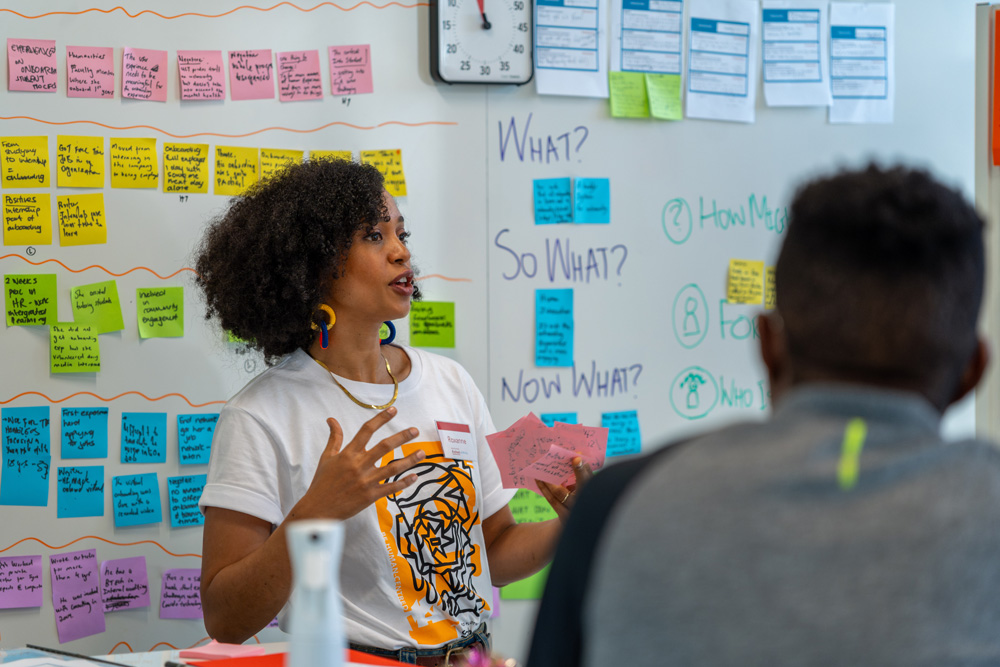
Facilitating sense-making and reflection during a design thinking programme at d-school Afrika.
And around that same time, you realise that some challenges simply don’t behave the way challenges should. Some problems simply no longer present themselves neatly. They shift, evolve, and widen as industries change. They surface in one department but originate in another. They involve people with different priorities, needs, and definitions of success.
And they rarely have a single “right” answer.
These are what we call wicked problems: complex, interdependent issues that refuse to be solved through traditional methods. They resist checklists, linear workflows, or isolated decision-making. To find any feasible path through them requires creativity, collaboration, and a way of thinking that accounts for human behaviour in all its unpredictability.
This is where design thinking comes alive, not as a trendy method, but as one of the few problem-solving approaches in business capable of addressing the messy reality of wicked problems.
Most problem-solving techniques in business lean heavily on logic, analysis, and precedent. They assume the world behaves predictably. But wicked problems, like improving employee well-being, transforming customer experiences, or redesigning internal processes, don’t follow straight lines.
Design thinking embraces this non-linearity.
It combines purposeful reflection, curiosity, empathy and human-centered mindsets to help teams explore what could be, not just what has been. Instead of trying to force a complex issue into a simple framework, design thinking widens the lens. It encourages teams to slow down, listen deeply, collaborate across silos, and test their ideas in real-world contexts.
Design thinking is especially powerful when we’re faced with challenges that involve shifting behaviours, needs, and emotions, the kinds of problems that don’t have a single, straightforward answer. But design thinking can be applied to a wide range of challenges, no matter their complexity, because its real strength lies in helping teams navigate ambiguity and design solutions that respond to the realities of the people they serve.
The design thinking process isn’t a straight line. It loops, shifts, and repeats. But its phases give teams a shared language and a common direction, essential when tackling complex, ambiguous challenges.
Every project starts with empathy. Businesses pause their assumptions and look outward, immersing themselves in the lived experiences of customers, colleagues, or communities.
Teams gather stories, observe behaviours, explore industry trends, and understand pain points and aspirations. This step reminds us that innovation doesn’t happen in a vacuum, it happens within real lives, real constraints, and real needs.
Empathy is what turns creative problem solving from a technical exercise into a human one.
Without it, we solve the wrong problems.
Once the team understands the people involved, they shift into sense-making.
Here, patterns start to appear. User needs become clearer. Hidden assumptions come to the surface. Teams use tools like journey maps and storyboards to visualise the ecosystem that surrounds the challenge: the frustrations, motivations, systemic barriers, and missed opportunities.
This is often where a problem transforms.
What first appeared as a “surface issue” becomes something much deeper and more meaningful to solve.
Only once the team understands the problem do they explore solutions. This is the playful, energetic, generative part of the design thinking process, where creativity takes centre stage.
Teams sketch. They brainstorm. They push boundaries. They timebox ideas to encourage momentum, not perfection. They explore unconventional approaches without the pressure of being right.
In this phase, quantity matters. Curiosity matters. And the aim is simple: imagine possibilities without constraint.
Ideas become tangible once they are translated into prototypes. These are intentionally incomplete: rough versions of a solution designed not to impress but to learn. Instead of focusing on a single polished solution, teams are encouraged to always iterate their rough solutions.
The purpose is clarity: What is the core of the solution? What matters most? What can be built quickly and tested today?
Prototypes keep teams focused on what users truly need, rather than what businesses assume they need.
Finally, teams return to the people they met at the beginning. They test. They observe. They refine. Sometimes the solution works beautifully. Other times, the team realises it needs to circle back and try again.
This iterative rhythm is what makes design thinking so powerful for addressing wicked problems. Each test reveals something new, something human, something essential.
And through each cycle, the solution becomes more grounded, more relevant, and more likely to succeed in the real world.
Beyond its human impact, design thinking delivers measurable business value. Companies that embed it into their strategy improve collaboration and decision-making, which leads to more innovative outcomes. By adopting creative problem solving as part of their culture, these organisations gain a powerful edge in attracting talent and responding to change.
But design thinking is not a one-size-fits-all formula. It’s a flexible framework that adapts to the unique challenges of each team or organisation. Whether used to design customer experiences, reshape internal processes, or reimagine workplace culture, its principles, empathy, experimentation, and collaboration, remain universal.
Design thinking gives structure to imagination and turns curiosity into capability.
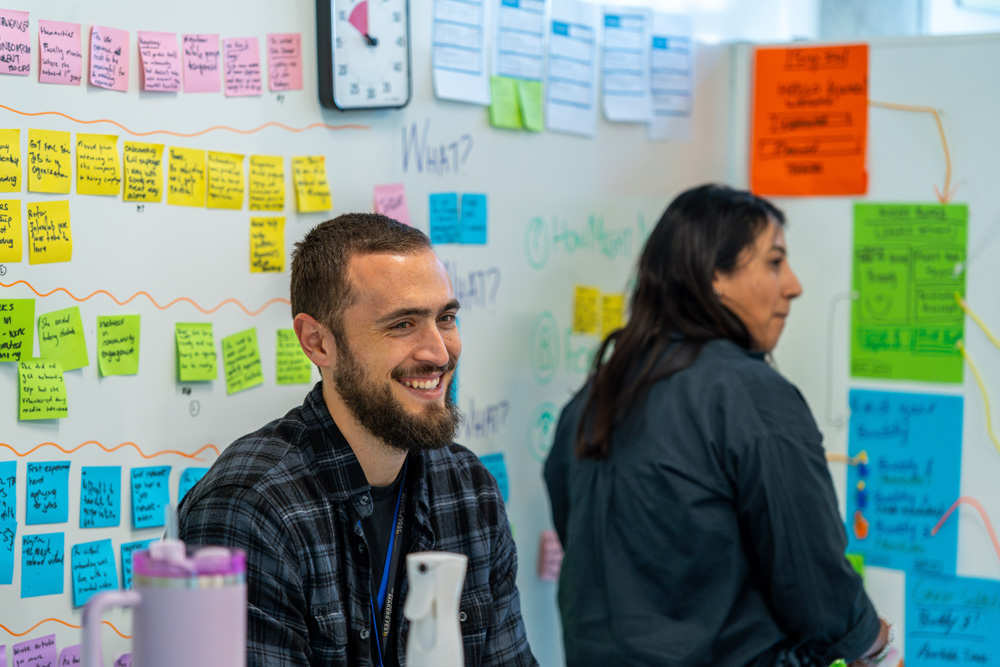
Participants collaborating and visualising ideas as part of the design thinking process.

Wicked problems don’t ever truly go away. But organisations can learn to approach them with confidence, curiosity, and creative capability.
This is the purpose of Design Thinking in Practice, d-school Afrika’s immersive, three-day programme for professionals who are ready to lead change in real work environments.
This 3-day course helps teams:
Since 2016, d-school Afrika has delivered:
Every organisation has its own wicked problems. The Design Thinking in Practice programme gives your teams the tools to approach them with creativity, discipline, and empathy, the foundations of meaningful innovation.

Wicked problems are a given part of any workspace, but so is human creativity. When organisations embrace design thinking, they transform how people work, learn, and collaborate. They build workplaces where imagination is encouraged, insights are shared, and solutions emerge through collective intelligence.
In a world where customer needs are constantly growing more complex, that mindset is the strategic advantage your team needs to thrive.

Copyright 2025 Hasso Plattner d-school Afrika*