

10 minutes

Acting out a concept - exploring how users might experience the idea in real life.
This is where many projects go off track. Not because teams lack creativity or skill, but because they jumped to solutions before they truly understood the challenge. And when the framing is unclear, even brilliant solutions can miss the mark.
There's pressure to have answers. To take action. To show progress. In fast-paced environments, slowing down to frame the problem can feel counterproductive. But what gets lost when teams rush ahead? Alignment. Clarity. Shared understanding of what success looks like.
Without clear framing, teams often discover midway through a project that everyone has been working toward slightly different goals. Or worse, they realise they've been addressing symptoms rather than root causes. A new app won't solve a trust issue. A policy change won't fix a communication breakdown. The solution might be well-executed, but if it's solving the wrong problem, it won't create the impact the team hoped for.
The design thinking process deliberately slows teams down at the start. The early phases, Understand, Observe, and Define, are about building a foundation before exploring solutions. They create space to ask: What are we not seeing? Whose perspective matters here? What assumptions are we bringing to this challenge?
This isn't about overthinking. It's about ensuring the work that follows is focused on the right challenge. A well-framed problem opens up richer possibilities. A poorly framed one locks teams into narrow, surface-level solutions.
Teams that take time to frame meaningfully are able to say with confidence: "This is the challenge we're working on, and here's why." That clarity makes all the difference.
Real-world challenges don't arrive neatly packaged. They're layered, ambiguous, and embedded in complex systems. A brief might say "improve engagement" or "increase efficiency," but what does that actually mean? For whom? In what context? What's driving the issue?
Good framing transforms this messiness into direction. It takes observations, research, stakeholder stories, and lived experiences, and synthesises them into a focused challenge statement that's clear, human-centred, and strategically aligned.
This is where critical thinking skills become essential. Teams need to distinguish between what people say they need and what their behaviour reveals. They need to separate symptoms from root causes. They need to identify core tensions, not just surface frustrations. And they need to refine broad issues into focused intervention points without losing sight of what matters.
These are skills that can be learned and practiced. And they're what turn vague briefs into challenges worth solving.
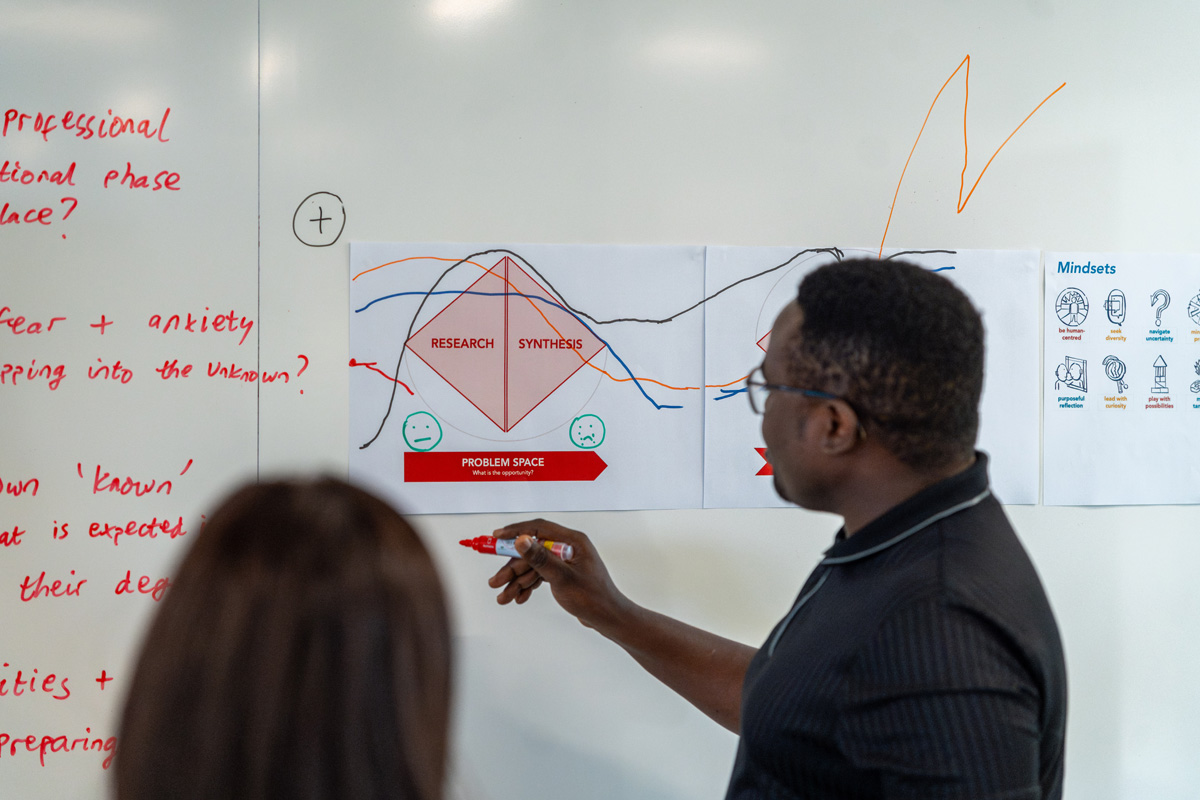
Workshopping the challenge so the team can align before ideating.

Most programmes teach people how to solve predefined problems. But in real-world contexts, especially collaborative or partnership-based work, the challenge isn't always clear from the start. Learning to confidently frame the right problem is what determines whether a project creates value or becomes misaligned.
This is the focus of programmes designed around creative problem solving and challenge framing. They create conditions for people to practice moving from complexity to clarity, building problem statements from observations and data, and scoping challenges that align personal learning goals with organisational needs.

A one-day, hands-on design thinking experience
What you'll learn:
Who it's for:
Individuals aged 18–35 curious about human-centred problem framing. Students working on partnership projects, emerging professionals navigating ambiguity, anyone engaged in collaborative or industry-linked work. No prior design thinking experience required.
Why it matters:
Build the confidence to say: "This is the challenge we're working on, here's why it matters, and here's how I arrived at this framing." That clarity changes how you work, collaborate, and create impact.
Framing isn't about delaying action. It's about ensuring the action you take is focused on work that matters. The smartest teams don't just solve problems well, they make sure they're solving the right problem in the first place.
Learning to frame meaningful challenges is a skill that transfers across contexts: academic work, organisational partnerships, entrepreneurship, career decisions, and personal growth. It's what turns messy reality into meaningful direction. And it starts with a willingness to pause, observe, and ask better questions before jumping to solutions.
Because the problem before the solution? That's where everything begins.

Copyright 2026 Hasso Plattner d-school Afrika*